



Week of October 5, 2026
Published every Monday: Get a detailed snapshot of what moved the markets last week—and what to watch this week.
Consumers are concerned, but fundamentals remain strong.
Stocks were generally lower last week, with only the Nasdaq Composite eking out a gain. Breadth remained weak, with only three sectors posting positive returns. Fixed income markets continued to exhibit weakness as 10- and 30-year Treasury yields hit a 24-year high.
Weekly Quick Hits
![]()
Insights into the Federal Reserve’s (Fed’s) rationale and consumer confidence data will be the focus this week.
BEYOND THE HEADLINES:
Consumers are concerned, but fundamentals remain strong.
Many headwinds have battered the U.S. economy over the past couple of years, leading to higher prices for many items. As reflected in Consumer Price Index (CPI) data, inflation has remained above the Fed’s 2 percent target since 2020.
Higher prices for goods and the resulting higher costs of loans and credit card debt have affected household budgets. Yet one constant through it all has been the resilience of consumers, who have continued to spend. Because consumers account for roughly 70 percent of the U.S. economy, they are critical to economic growth.
Consumer Confidence Reaches 12-Year Low
The most recent Conference Board Consumer Confidence Index was well below economists’ expectations and now sits at its lowest level in 12 years. It was hard to find good news in the release, with views on both present conditions and future expectations declining. At the same time, consumer perceptions of the labor market weakened significantly. The gap between respondents who said jobs were plentiful and those who said jobs were hard to get fell to its lowest level since February 2021, when the economy was still recovering from the pandemic.
It’s easy to understand why consumers feel the way they do.
Jobs and Inflation Inform Consumers’ Outlook
The war between Russia and Ukraine changed the trajectory of inflation in the U.S. Higher oil and food prices, combined with the impact on global supply chains, caused inflation to reach levels last seen in the early 1980s. CPI has declined since peaking at 9.1 percent in June 2022. Since then, however, tariffs and the war in the Middle East have caused it to reaccelerate, weighing on consumer confidence.
Consumers are also concerned about the state of the labor market. While investors have a razor-sharp focus on the monthly jobs report, the trend seems to indicate a labor market that is in equilibrium. In other words, corporations aren’t laying off employees in large numbers—but they also aren’t hiring new ones. Despite the weaker September employment report, the three-month average now stands at 50,000–51,000 jobs created per month. A bigger concern might be that wage growth isn’t keeping up with inflation, which could be a drag on retail sales.
Markets Climb the Wall of Worry
Several risks have materialized in 2026, including higher oil prices, rising U.S. debt, and Treasury yields approaching 25-year highs. Each time the market could have weakened, however, it has found its footing and moved higher. The biggest reason? Strong fundamentals, led by earnings growth from corporate America. If earnings growth over the next month matches analysts’ expectations and results in a third consecutive quarter of 25 percent growth, the market could move higher again. The looming holiday shopping season could test whether consumers will continue to spend despite their concerns.
“The most recent Conference Board Consumer Confidence Index was well below economists' expectations and now sits at its lowest level in 12 years. It was hard to find good news in the release, with views on both present conditions and future expectations declining.”
Report Releases: —September 28–October 2, 2026
Conference Board Consumer Confidence Index:
September (Tuesday)
Consumer confidence fell more than expected last month due to worsening views on current and future economic conditions.
- Expected/prior month consumer confidence: 89.0/88.6
- Actual consumer confidence: 81.9
Institute for Supply Management (ISM) Manufacturing Index:
September (Thursday)
Although activity slowed moderately last month, the manufacturing sector has enjoyed nine consecutive months of expansion.
- Expected/prior month ISM Manufacturing index: 55.0/54.6
- Actual ISM Manufacturing index: 54.5
Employment Report:
September (Friday)
Hiring slowed notably last month, with a disappointing 29,000 jobs added versus expectations of 90,000. The unemployment rate ticked up to 4.2 percent.
- Expected/prior change in nonfarm payrolls: +90,000/+133,000
- Actual change in nonfarm payrolls: +29,000
The Takeaway
- The September employment report was weaker than expected, with only 29,000 jobs created. Employment figures from the previous two months were revised lower by 60,000 jobs.
- Weaker employment growth calls into question whether the Fed will raise rates again this month.
Financial Market Data
Equity
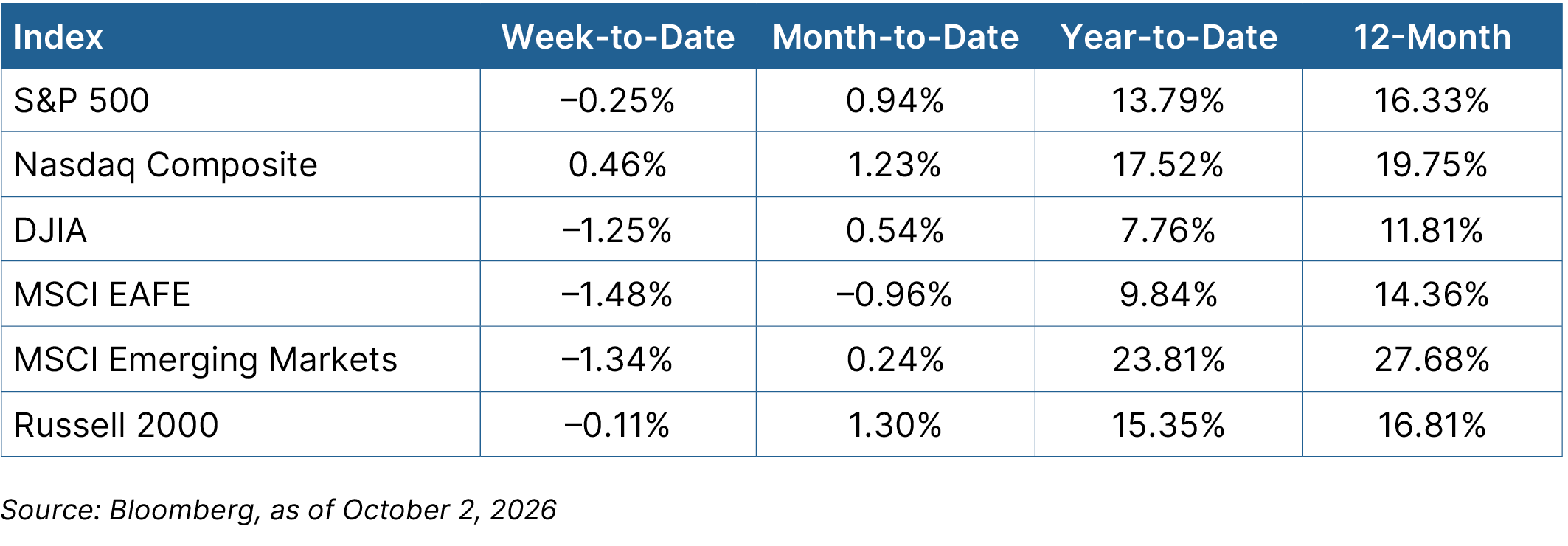
Global stocks were mostly lower, with only the Nasdaq Composite closing in positive territory. Breadth remained weak; the equal-weight S&P 500 closed lower for the seventh consecutive week. As a result, the Dow Jones Industrial Average, the S&P 500, and the Russell 2000 declined. Technology, energy, and utilities were the only sectors to post positive returns. Health care, financials, consumer staples, real estate, and communication services each declined more than 1.5 percent. International markets also fell, with developed and emerging markets down more than 1 percent.
Fixed Income
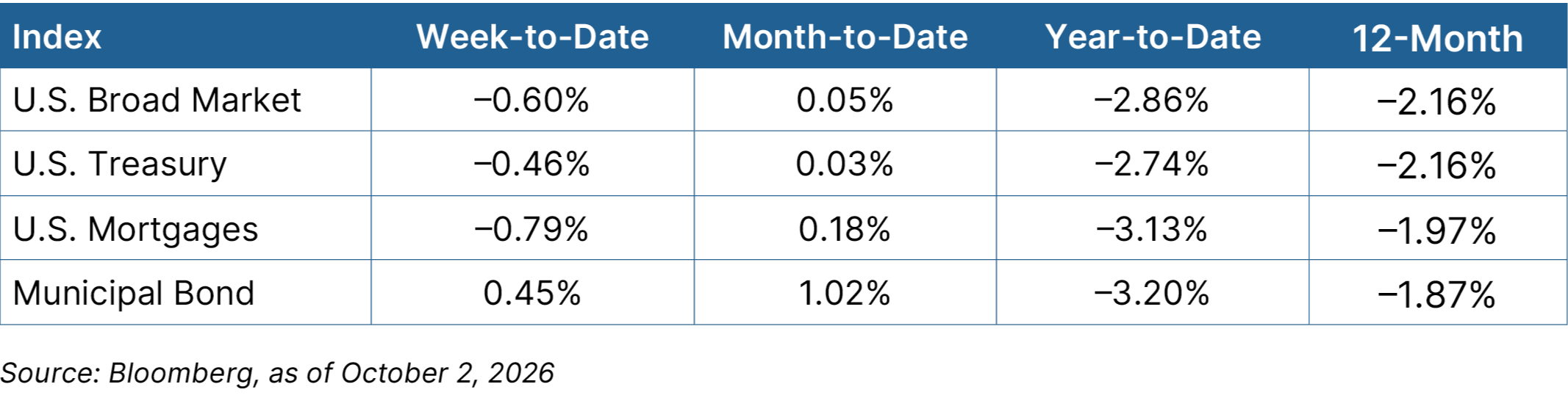
Although the September employment report lessened the odds that the Fed will hike rates this month, the Treasury yield curve steepened, with 10- and 30-year yields reaching 24-year highs before pulling back slightly at the end of the week. The 10-year closed at 5.28 percent. Core bonds, Treasuries, and mortgages declined. The municipal market managed a small gain.
The Takeaway
- Stocks were mostly lower, with the exception of the Nasdaq Composite. Breadth remained weak.
- Bond markets continued their downward trend, with 10- and 30-year Treasury yields reaching 24-year highs.
Looking Ahead
Economic data will once again be in focus this week, and minutes from the Fed’s meeting last month should provide insight into why the central bank raised interest rates.
- The week kicks off on Monday with the ISM Services index for September. It’s anticipated that service sector confidence will decline modestly.
- On Wednesday, minutes from the September meeting of the Federal Open Market Committee (FOMC) will be released. Economists and investors will watch closely to better understand why the Fed raised interest rates.
- Finally, on Friday, we expect the preliminary University of Michigan consumer sentiment survey for October. Concerns about inflation and the economy are expected to persist.
Disclosure: This material is intended for informational/educational purposes only and should not be construed as investment advice, a solicitation, or a recommendation to buy or sell any security or investment product. Diversification does not assure a profit or protect against loss in declining markets, and diversification cannot guarantee that any objective or goal will be achieved. Please contact your financial professional for more information specific to your situation.
Bonds are subject to availability and market conditions; some have call features that may affect income. Bond prices and yields are inversely related: when the price goes up, the yield goes down, and vice versa. Market risk is a consideration if sold or redeemed prior to maturity.
Certain sections of this commentary contain forward-looking statements that are based on our reasonable expectations, estimates, projections, and assumptions. Forward-looking statements are not guarantees of future performance and involve certain risks and uncertainties, which are difficult to predict. All indices are unmanaged and are not available for direct investment by the public. Past performance is not indicative of future results. The S&P 500 is based on the average performance of the 500 industrial stocks monitored by Standard & Poor’s. The Nasdaq Composite Index measures the performance of all issues listed in the Nasdaq Stock Market, except for rights, warrants, units, and convertible debentures. The Dow Jones Industrial Average is computed by summing the prices of the stocks of 30 large companies and then dividing that total by an adjusted value, one which has been adjusted over the years to account for the effects of stock splits on the prices of the 30 companies. Dividends are reinvested to reflect the actual performance of the underlying securities. The MSCI EAFE Index is a float-adjusted market capitalization index designed to measure developed market equity performance, excluding the U.S. and Canada. The MSCI Emerging Markets Index is a market capitalization-weighted index composed of companies representative of the market structure of 26 emerging market countries in Europe, Latin America, and the Pacific Basin. The Russell 2000® Index measures the performance of the 2,000 smallest companies in the Russell 3000® Index. The Bloomberg US Aggregate Bond Index is an unmanaged market value-weighted performance benchmark for investment-grade fixed-rate debt issues, including government, corporate, asset-backed, and mortgage-backed securities with maturities of at least one year. The U.S. Treasury Index is based on the auctions of U.S. Treasury bills, or on the U.S. Treasury’s daily yield curve. The Bloomberg US Mortgage Backed Securities (MBS) Index is an unmanaged market value-weighted index of 15- and 30-year fixed-rate securities backed by mortgage pools of the Government National Mortgage Association (GNMA), Federal National Mortgage Association (Fannie Mae), and the Federal Home Loan Mortgage Corporation (FHLMC), and balloon mortgages with fixed-rate coupons. The Bloomberg US Municipal Index includes investment-grade, tax-exempt, and fixed-rate bonds with long-term maturities (greater than 2 years) selected from issues larger than $50 million. One basis point is equal to 1/100th of 1 percent, or 0.01 percent.
Authored by the Investment Research team at Commonwealth Financial Network®.
© 2026 Commonwealth Financial Network®
Let’s Talk About Your Financial Future
Whether you’re navigating a volatile market or preparing for the future, we’re here to help.